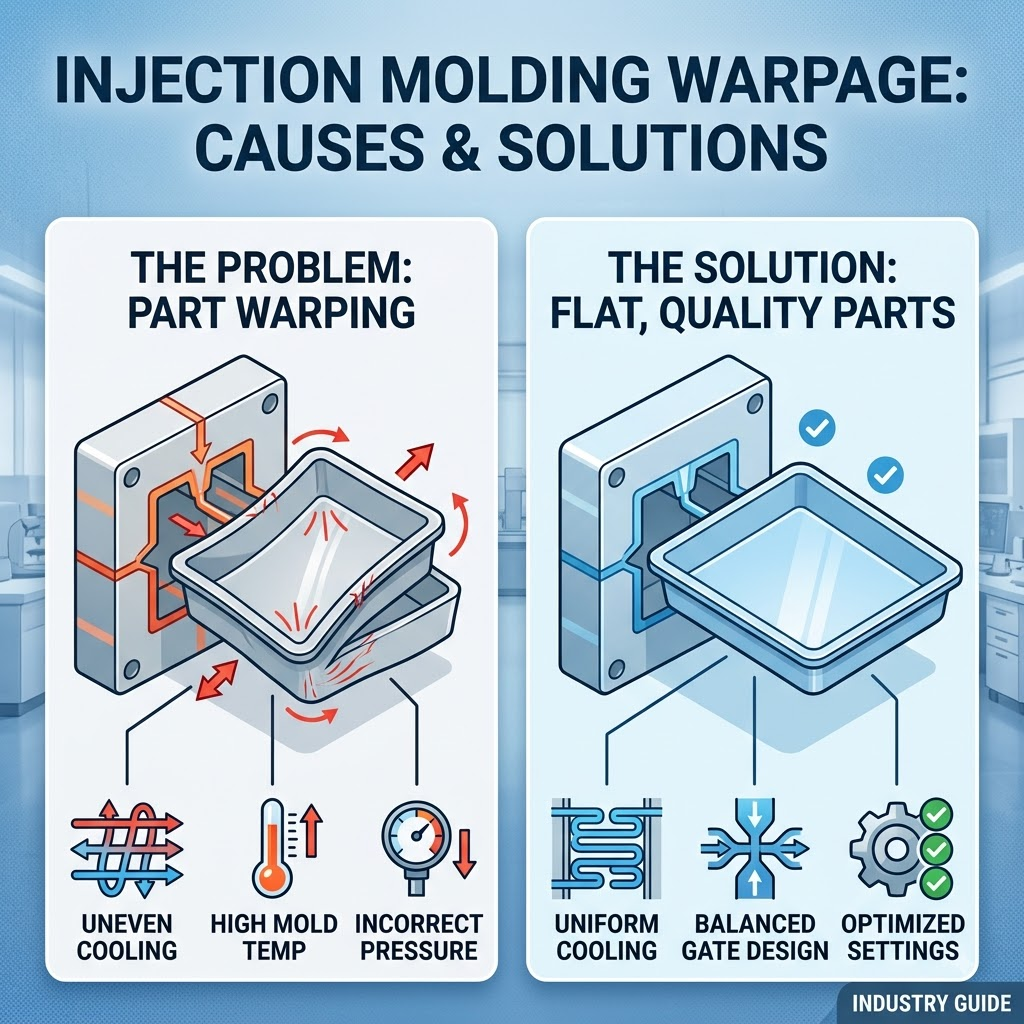
I've spent more hours than I care to count staring at warped plastic parts, trying to figure out exactly what went wrong. You pull a part out of the mold, it looks fine for a second, and then—right in front of you—it starts to curl, twist, or bow like it's got a mind of its own. Frustrating doesn't quite cover it.
Here's the thing about injection molded parts: warpage isn't just a cosmetic issue. It's a functional one. A warped part might not fit in its assembly. It might create stress points that lead to premature failure. And in some cases, it means scrapping entire production runs.
The good news? Warpage is predictable, and it's preventable. Once you understand what's actually happening inside that mold, you can take control of the process instead of just reacting to defects.
Table of Contents
1. What Exactly Is Warpage in Injection Molding?
2. The Root Causes of Warpage
3. Material-Related Factors
4. Part Design Contributions
5. Processing Parameters That Matter
6. Mold Design and Cooling
7. Practical Solutions and Fixes
8. Case Study: Warpage Reduction Using Inverse Contouring
9. Troubleshooting Quick Reference
10. FAQ
11. Conclusion
What Exactly Is Warpage in Injection Molding?
Warpage is the deformation of a molded part—bending, twisting, or bowing—that happens when different areas of the part shrink unevenly during cooling . It's not the same as sink marks or short shots. Warpage is a shape change, a distortion of the geometry you designed into the mold .
And here's what makes it tricky: the part can look perfectly fine right after ejection, then warp as it continues to cool and stabilize .
The physics behind this is actually pretty straightforward. When molten plastic is injected into a mold, it cools from the outside in. The material that contacts the mold surface solidifies first, forming a "skin." The core takes longer to cool. If that cooling isn't uniform—if one side cools faster than the other, or if thick sections cool slower than thin ones—internal stresses build up . The part warps as a way of relieving those stresses.
The Root Causes of Warpage
From what I've seen across hundreds of production runs, warpage usually traces back to one of three sources:
Residual Stresses
This is the big one. Residual stresses are stresses that remain in the part even after all external forces are removed. They come in two flavors :
Flow-induced stresses happen when polymer molecules are stretched and oriented in the direction of flow as they're forced into the cavity. The molecules want to return to their natural, coiled state, but rapid cooling "freezes" them in place . Think of a rubber band held stretched—it's storing energy. Release it, and it springs back. Same idea with plastic molecules.
Thermal-induced stresses are caused by uneven cooling across the part thickness. The skin freezes, the core shrinks, and the frozen layers constrain that shrinkage. This creates tension in the core and compression in the outer layers .
Uneven Shrinkage
Shrinkage is just what happens when plastic cools from melt temperature to room temperature—it takes up less volume . The problem comes when shrinkage isn't uniform. If one area shrinks 2% and another shrinks 1%, you get warpage.
Asymmetric Cooling
This is probably the most common cause I see in the field. If one side of the mold is hotter than the other, the part will cool unevenly and warp toward the hotter side . A study found that a temperature difference of even 1°C between mold halves can produce measurable warpage .
Material-Related Factors
Not all plastics behave the same way, and choosing the wrong material can set you up for warpage from the start.
Crystalline vs. Amorphous Polymers
Semi-crystalline materials like polypropylene (PP) and polyamide (PA) tend to shrink more than amorphous materials like ABS and polycarbonate (PC). That's because crystalline regions pack more tightly as they cool, creating greater volume reduction .
If you're designing a part that needs tight dimensional stability, amorphous materials are often the safer choice.
Filled Materials
Glass-filled materials add another layer of complexity. The glass fibers align in the direction of flow, and shrinkage is restricted along that fiber direction . If flow isn't balanced—if fibers orient differently in different areas—you get differential shrinkage.
Moisture Sensitivity
Some polymers absorb moisture after molding, which can cause post-mold dimensional changes that mimic warpage . Nylon is notorious for this. If you're seeing warpage develop days after production, moisture absorption might be the culprit.
Part Design Contributions
Here's where a lot of warpage gets baked in before the first shot is ever run.
Uneven Wall Thickness
This is rule number one: keep wall sections as consistent as possible. Thicker sections cool slower than thinner ones, and that differential cooling creates stress . If you absolutely need varying thicknesses, transition gradually using fillets or tapers.
Large Flat Areas
Big, flat surfaces are warpage magnets. They cool unevenly and have no structural features to resist bending. Adding ribs can stiffen the part without creating thick sections .
Asymmetric Geometry
Symmetrical designs shrink more evenly. When you can't make a part symmetric, you need to design countermeasures—balanced ribbing or thicker opposite walls . The part will always warp toward the hotter side, or toward the side that cools last.
Processing Parameters That Matter
Even with perfect material selection and part design, the wrong processing conditions can ruin your day.
Melt and Mold Temperature
Higher melt temperatures create larger temperature gradients between the hot plastic and the cool mold surface, which can increase shrinkage . But here's the catch: complex molds might need high temperatures just to get the plastic to flow through narrow sections. It's a balancing act.
Packing and Holding Pressure
Insufficient packing pressure allows uneven shrinkage between thick and thin regions . Research shows that for conventional injection molding, pack/hold pressure and pack/hold time have the most significant effect on shrinkage and warpage . Get this wrong, and you're fighting an uphill battle.
Cooling Time
I've seen operators try to rush the cooling phase to save cycle time. Bad idea. Inadequate cooling before ejection lets the part continue to shrink outside the mold, where it's not constrained, leading to warpage . One study identified cooling time as the most significant parameter for reducing warpage .
Mold Temperature Differential
This one is critical. Keep mold half temperature differentials within ±2°C to prevent directional warp . If one half is hotter, the part will warp toward it.
Mold Design and Cooling
The mold itself is where a lot of warpage battles are won or lost.
Cooling Channel Layout
Poorly distributed cooling lines create temperature gradients that directly cause warpage . Channels should be spaced evenly and kept at a consistent distance from the cavity surface.
Gate Location
Gate position determines flow paths and packing efficiency. Asymmetric gating can create uneven shrinkage . Where possible, use multiple or symmetrically placed gates to balance the flow.
Conformal Cooling
For complex geometries, conformal cooling channels—created through additive manufacturing—can improve temperature uniformity dramatically . These channels follow the shape of the part instead of being limited to straight drilled lines.
Mold Venting
Inadequate venting traps air, which affects pressure distribution and contributes to inconsistent packing .
Practical Solutions and Fixes
Here's what to do when you're facing warpage:
Part Design
Keep wall sections uniform. Variations = stress.
Use ribs instead of thick walls for stiffness .
Add draft angles and radii to reduce stress concentrations .
Design for symmetry when possible.
Process Optimization
Increase packing pressure or extend hold time, especially for thicker zones .
Extend cooling time—ensure parts cool below the glass transition temperature before ejection.
Balance mold temperature—maintain consistent temperature with proper cooling design.
Consider annealing for semi-crystalline materials to relieve residual stress .
Material Strategies
Choose low-shrinkage polymers where dimensional stability is critical.
Use fillers carefully—they reduce shrinkage but can create orientation issues.
Control fiber orientation through gate placement and flow paths .
Simulation
Mold flow simulation software has come a long way. Testing gating strategies, cooling layouts, and flow paths virtually before cutting steel can save you a huge headache . The technology predicts warpage risks early enough to make meaningful design changes.
Case Study: Warpage Reduction Using Inverse Contouring
A 2025 study published in the OpenLB journal took a systematic approach to warpage reduction using a two-step method .
The part: A component made of polybutylene terephthalate (PBT) with 30% glass fiber reinforcement.
Initial warpage: 1.85 mm based on Moldflow simulation.
Step 1 - Process optimization: Using Response Surface Methodology (RSM), the team optimized melt temperature, mold temperature, and coolant temperature. Warpage dropped to 0.73 mm.
Step 2 - Inverse contouring: Here's where it gets clever. The researchers redesigned the mold cavity to intentionally incorporate compensatory deviations—essentially warping the mold in the opposite direction of the predicted part warpage. After this second iteration, warpage was reduced to within ±0.30 mm.
Result: Approximately 82% reduction in warpage .
What's notable here is that inverse contouring acknowledges a reality I've seen in the field: sometimes you can't eliminate the root causes of warpage completely, but you can design the mold to compensate for them.
Troubleshooting Quick Reference
Symptom | Likely Cause | Corrective Action |
Part bends toward thicker section | Uneven cooling through thicker walls | Balance wall thickness; improve cooling near thick areas |
Corners lift or twist | Asymmetric geometry or fiber orientation | Modify gate location; adjust flow direction |
Part bows in one direction | Temperature gradient across part | Improve cooling uniformity; balance mold temperature |
Sink marks and local warpage | Low packing pressure | Increase holding pressure/time |
Warpage worse after ejection | Part not cooled below glass transition temperature | Extend cooling time |
Parts warp toward one mold half | Unequal mold half temperatures | Balance cooling; heat the colder half |
FAQ
What's the most common cause of warpage?
Uneven cooling, hands down. Either through asymmetric part geometry (thick vs. thin sections) or unbalanced mold temperatures .
Which materials warp the least?
Amorphous polymers like PC, PMMA, and ABS generally show more predictable, isotropic shrinkage than semi-crystalline materials . But material selection is just one piece of the puzzle.
Can you fix a warped part after molding?
Sometimes. Annealing can relieve residual stress in semi-crystalline materials . But it's far better to prevent warpage than to try fixing it afterward.
What's inverse contouring?
A mold design technique where the cavity is intentionally modified in the opposite direction of expected warpage. The part warps into the desired shape .
Why do my parts warp differently from one run to the next?
Check your process stability. Even small variations in melt temperature, mold temperature, or cooling time can change warpage outcomes. Also check for moisture—some materials absorb humidity over time .
What's a realistic warpage tolerance?
It depends on the application, but for precision parts, a recent optimization study achieved warpage within ±0.30 mm . For less critical applications, you might have more flexibility.
Conclusion
Injection molded parts warp because of residual stresses that develop during cooling. Those stresses come from uneven shrinkage, asymmetric part geometry, unbalanced mold temperatures, or processing conditions that don't give the part enough time to solidify properly.
The good news is that warpage is manageable when you address it systematically. Uniform wall thickness, balanced cooling, proper packing pressure, and adequate cooling time all matter. And if you're still fighting warpage after optimizing the basics, techniques like inverse contouring offer a path forward.
I've seen production lines go from 20% scrap to under 2% just by taking these fundamentals seriously. The physics doesn't change. What changes is how well you understand and control the variables.
If you're dealing with warpage issues right now, start by measuring the temperature difference across your mold halves. Then check your wall thicknesses and cooling time. I'll bet you find the culprit in one of those three places.