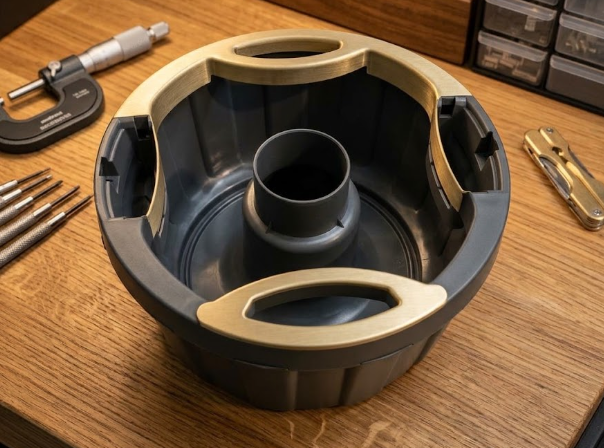
A washing machine injection mold has to do more than reproduce an attractive outline. It must form a part that fits the assembly, survives repeated handling, resists detergent and moisture where required, and remains stable when produced cycle after cycle. For that reason, a washing machine injection mold manufacturer needs to review the part, material, mold structure, cooling plan, ejection method, and inspection points as one connected system.
Contents
1. Begin with the part function, 2. Review geometry before steel is cut, 3. Plan filling and cooling, 4. Control warpage and assembly fit, 5. Validate the tool for production, 6. Frequently asked questions.
Begin With the Function of the Part
Washing machines contain visible covers as well as hidden brackets, boxes, caps, dampers, and support components. A top cover is judged by appearance and fit. A water inlet box must guide or contain water without creating an assembly problem. A spring cap or damper-related part may need reliable positioning and repeatable dimensions. The mold strategy should follow the job each part performs rather than treating every plastic component as a simple shell.
The design review should clarify the mating parts, fastening method, expected loads, surface requirements, and service environment. It should also identify which surfaces will be visible after assembly. That information helps the mold team decide where to place the parting line, gates, ejectors, slides, inserts, and texture. These choices are difficult to correct after machining, so they belong in the first review, not at the end of the project.
Design input | Why it matters | Questions for the mold review |
Mating parts and gaps | Small dimensional drift can create visible steps, interference, or noise. | Which dimensions control assembly and which are cosmetic? |
Material and additives | Shrinkage, flow, moisture, and heat behavior affect tooling decisions. | Is the resin reinforced, flame-retardant, filled, or detergent-resistant? |
Surface appearance | Gloss, texture, weld lines, and gate marks can change the visible finish. | Which surfaces require a specific texture or gate location? |
Service environment | Water, detergent, heat, vibration, and aging affect material choice and validation. | What exposure and life expectations should the part meet? |
Production quantity | A high-volume tool needs suitable steel, cooling, maintenance access, and cycle stability. | What annual volume and expected tool life should be planned? |
Review Geometry Before Steel Is Cut
A washing machine plastic part often combines broad surfaces, ribs, bosses, clips, openings, and transitions between thin and thick sections. Those features are useful in the product, but they also create different filling and cooling behavior. A design for injection molding should keep wall sections as consistent as practical, use ribs and bosses with sensible proportions, and provide draft on surfaces that must release from the cavity or core.
Draft is not simply a number added at the end. It must be considered with texture, ejection direction, shutoffs, and the visual position of the parting line. Deep ribs may require core features or lifters. Undercuts may call for slides, angled lifters, or a change to the product design. A careful washing machine injection mold manufacturer will flag these choices early and explain their effect on tool cost, cycle time, maintenance, and part appearance.
Plan Filling and Cooling Together
Gate position influences the flow path, weld-line location, packing efficiency, and the marks that remain on the finished component. For a large cover, an unbalanced flow path may produce uneven orientation or pressure distribution. For a box or housing with several openings, the gate and venting plan must allow air to leave the cavity while the melt reaches the far features. The correct layout depends on the part geometry and resin; there is no universal gate position that fits every washing machine mold.
Cooling deserves the same level of attention. Broad panels can retain heat, while thin edges and steel around inserts may cool at a different rate. Uneven cooling can contribute to sink marks, residual stress, or warpage after ejection. Cooling channels should be arranged around the actual hot spots and checked for access during maintenance. If a part is likely to distort outside the mold, the team should address the cause in design and process planning instead of relying on manual correction.
Control Warpage and Assembly Fit
Warpage is particularly troublesome in appliance covers because a small bow can change gaps, clip engagement, or the feel of a joint. The main influences include material shrinkage, wall variation, gate balance, packing, mold temperature, cooling time, and ejection. A sound mold review connects these factors to measurable inspection points. Critical flatness, hole position, clip location, and mating dimensions should be identified before trial production.
The first molding trial should not be judged only by whether a part comes out of the tool. Inspect the part after a defined cooling and conditioning period. Compare the result with the drawing and assembly reference, then separate tool-related issues from process settings. If a change is required, record the reason and its effect on cycle time, appearance, and dimensional stability.
Validate the Tool for Repeatable Production
A production-ready mold should be evaluated as a maintainable asset. Check cavity and core condition, cooling circuits, venting, ejection, sliders, replaceable wear components, and safe access for cleaning. Confirm that the mold identification, spare-part information, inspection records, and process notes are clear enough for the production team to use later. This is especially important when the tool will run at a site different from the original mold shop.
For a home appliance program, the practical goal is not a single attractive sample. It is a stable process that can make correctly fitting parts with predictable appearance and manageable maintenance. That outcome comes from aligning product design, mold engineering, material selection, trial work, and inspection before volume production begins.
Frequently Asked Questions
What washing machine parts can be injection molded?
Common examples include covers, frames, water inlet boxes, spring caps, damper-related parts, brackets, and other plastic housings or functional components. The suitable process depends on geometry, material, and performance requirements.
How can a mold team reduce warpage in a large appliance cover?
Start with uniform wall design, appropriate ribs, balanced filling, effective venting, a practical cooling layout, and a controlled packing and ejection plan. The final solution must be verified by molding trials and measurement.
Should material selection be completed before mold design?
Yes. Resin shrinkage, reinforcement, temperature behavior, surface requirements, and chemical exposure can all change gate, cooling, draft, and tolerance decisions.