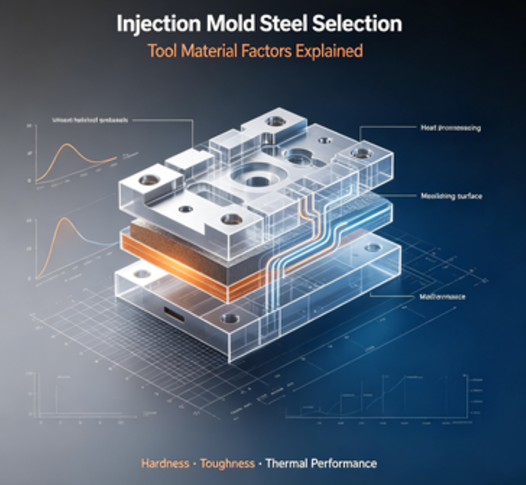
Introduction: Why Injection Mold Steel Selection Determines Tool Performance
In injection molding, people often focus first on the machine, cycle time, or plastic material. But experienced mold engineers know something else usually decides whether a tool performs well over years of production:
the steel selection.
Injection mold steel selection is not simply choosing the hardest material available. A mold that is too hard may become difficult to machine or polish. A mold that is too soft may wear quickly, lose dimensional accuracy, or fail under repeated injection pressure.
The right tool material must balance several factors:
· Mold production volume
· Plastic resin characteristics
· Required surface finish
· Corrosion resistance
· Wear resistance
· Machining requirements
· Heat treatment performance
· Maintenance expectations
For a prototype mold producing several thousand parts, a different steel choice may be correct compared with an automotive lighting mold expected to run millions of cycles.
This is why professional mold makers do not ask:
“Which mold steel is the best?”
The better question is:
“Which mold steel is best for this specific application?”
This guide explains the principles behind injection mold steel selection, helping mold buyers, engineers, and project managers understand how tool material decisions affect cost, quality, and production reliability.
Table of Contents
1. Why Injection Mold Steel Selection Matters in Mold Manufacturing
2. Key Properties That Determine Mold Steel Performance
3. Common Types of Injection Mold Steel and Their Applications
4. How Production Volume Influences Steel Choice
5. Matching Mold Steel With Plastic Materials
6. Surface Finish and Polishing Requirements
7. Heat Treatment and Manufacturing Considerations
8. Practical Mold Steel Selection Example
9. Common Questions About Injection Mold Materials
10. Final Guidelines for Choosing the Right Mold Steel
Why Injection Mold Steel Selection Matters in Mold Manufacturing
An injection mold operates under a demanding environment.
During every molding cycle, the mold experiences:
· High injection pressure
· Repeated thermal expansion and contraction
· Mechanical stress from mold opening and closing
· Abrasion from reinforced plastics
· Chemical exposure from certain resins
A typical injection mold may run hundreds of thousands or even millions of cycles.
According to industry studies and mold manufacturing standards, high-volume automotive and consumer product molds are commonly designed for 500,000 to several million cycles, depending on the application and maintenance conditions.
The mold steel directly influences:
· Tool lifespan
· Part dimensional stability
· Production consistency
· Maintenance frequency
· Total ownership cost
A cheaper steel choice may reduce initial mold cost, but it can create higher production expenses later if polishing, repair, or replacement becomes frequent.
The Core Factors Behind Injection Mold Steel Selection
There is no universal mold steel that fits every project.
Professional toolmakers usually evaluate several technical factors before selecting material.
1. Wear Resistance
Wear resistance describes how well the steel withstands surface damage caused by repeated contact.
This becomes especially important when molding:
· Glass-filled nylon (PA GF)
· Carbon fiber reinforced plastics
· Mineral-filled materials
· Abrasive engineering plastics
For these applications, tool steel with higher hardness and carbide-forming elements is usually preferred.
Common alloying elements that improve wear resistance include:
· Chromium (Cr)
· Vanadium (V)
· Molybdenum (Mo)
2. Toughness and Impact Resistance
Hardness is important, but excessive hardness can reduce toughness.
A mold insert must survive:
· Clamping force
· Ejection stress
· Thermal cycling
· Mechanical impact
For large molds or molds with thin cores, toughness becomes critical.
A brittle steel may crack even though its hardness value looks excellent.
3. Corrosion Resistance
Some plastic materials release corrosive gases during processing.
Examples include:
· PVC
· Certain flame-retardant plastics
· Materials containing aggressive additives
For these applications, stainless mold steels such as 420-type materials are commonly considered because they provide better corrosion resistance compared with conventional tool steels.
4. Polishability
For optical parts, transparent components, and high-gloss surfaces, polishing performance is one of the most important criteria.
Typical applications include:
· Automotive lenses
· Medical components
· Consumer electronics housings
· Optical parts
A mold steel must have:
· Uniform microstructure
· Low inclusion level
· Good cleanliness
· Stable heat treatment behavior
Even a very hard steel will not produce a perfect mirror finish if the material quality is poor.
Common Injection Mold Steel Types and Their Applications
Different steel grades are designed for different molding requirements.
The following table summarizes commonly used materials:
Mold Steel Type | Typical Hardness Range | Main Advantages | Common Applications |
P20 Pre-hardened Steel | Approx. 28–35 HRC | Easy machining, good cost balance | General plastic molds, housings, medium production |
718 / 718H Steel | Approx. 33–38 HRC | Better polishability and toughness | Consumer products, automotive parts |
H13 Tool Steel | Approx. 45–52 HRC after treatment | High thermal fatigue resistance | Hot environments, high-temperature tooling |
S136 Stainless Steel | Approx. 48–52 HRC after treatment | Excellent corrosion resistance and polishing | Optical parts, medical molds |
NAK80 Steel | Approx. 37–43 HRC | Excellent mirror finishing | High-gloss plastic parts |
1.2344 / 1.2343 Tool Steel | Approx. 45–52 HRC | Strong wear and heat resistance | Engineering plastic applications |
Note: Actual hardness depends on supplier condition, heat treatment process, and mold requirements.
How Production Volume Affects Mold Steel Selection
One of the most important factors in mold material selection is expected production quantity.
A prototype mold and a mass-production mold have completely different requirements.
A useful industry approach is:
Expected Mold Life | Typical Production Situation | Common Material Strategy |
Below 10,000 cycles | Prototype or testing | Aluminum, soft steel, low-cost materials |
10,000–300,000 cycles | Low to medium production | P20, 718-type steels |
300,000–1,000,000 cycles | Commercial production | Hardened tool steels, stainless steels |
Above 1,000,000 cycles | High-volume manufacturing | Premium hardened steels |
For example:
A startup producing a new consumer product may not need an S136 mirror-finish mold immediately.
But an automotive supplier producing interior components for several years usually cannot compromise on steel quality because downtime costs are much higher than initial tooling investment.
Matching Mold Steel With Plastic Resin Characteristics
The plastic material itself strongly influences steel selection.
This is often overlooked by buyers who focus only on mold dimensions.
Standard Thermoplastics
Materials such as:
· ABS
· PP
· PE
usually have moderate wear requirements.
Common mold steels:
· P20
· 718
· 718H
These provide a good balance between cost and performance.
Glass-Filled Engineering Plastics
Materials such as:
· PA66 GF30
· PBT GF
· PPS GF
contain glass fibers that act almost like abrasive particles.
They can rapidly wear ordinary mold surfaces.
Recommended considerations:
· Higher hardness
· Better wear resistance
· Proper surface treatment
Materials like H13 or hardened stainless steels may be selected depending on the mold design.
Transparent and Optical Plastics
For:
· PC lenses
· PMMA optical covers
· Light guides
surface quality becomes the priority.
The steel must support:
· Mirror polishing
· Stable dimensions
· Low defect surfaces
Common choices include:
· S136
· NAK80
A Practical Workflow for Injection Mold Steel Selection
After understanding steel grades and their basic properties, the next question for most buyers is:
How do engineers actually choose the correct mold steel for a real project?
In professional mold manufacturing, material selection normally follows a structured process.
It is not decided by steel price first.
A reliable workflow usually starts with the final product requirements.
Step 1: Define the Mold Application
Before selecting steel, engineers need to understand the part itself.
Important questions include:
· Is the part cosmetic or functional?
· Does it require a mirror finish?
· Is dimensional accuracy critical?
· Will the plastic contain abrasive fillers?
· How many parts will be produced?
For example:
A simple PP storage box and a transparent automotive light guide may both be injection molded, but their steel requirements are completely different.
The first one may work well with a general-purpose mold steel.
The second one may require stainless steel with excellent polishing characteristics.
Step 2: Evaluate Production Volume and Tool Life Expectation
Production quantity is one of the strongest drivers in injection mold steel selection.
A company producing 20,000 prototype parts does not need the same tool investment as a manufacturer producing 5 million automotive components.
Typical considerations:
Production Requirement | Recommended Material Strategy | Reason |
Prototype validation | Aluminum or soft tooling steel | Faster machining, lower investment |
Medium production | P20, 718H type steels | Balanced cost and durability |
High-volume production | Hardened tool steels | Longer service life |
Precision optical or medical parts | Stainless mold steels | Better corrosion resistance and polishing |
The goal is not selecting the most expensive steel.
The goal is achieving the lowest total cost over the complete mold lifecycle.
Heat Treatment and Its Role in Mold Steel Performance
Steel selection and heat treatment cannot be separated.
Even a high-quality mold steel can fail if the heat treatment process is incorrect.
Heat treatment affects:
· Hardness
· Wear resistance
· Dimensional stability
· Toughness
· Internal stress
Common heat treatment processes include:
Pre-Hardening
Some mold steels are supplied already hardened.
Examples:
· P20
· 718H
Advantages:
· No additional hardening required
· Lower distortion risk
· Easier machining
This makes them popular for medium-complexity injection molds.
Vacuum Hardening
High-performance mold steels often use vacuum heat treatment.
Benefits include:
· Reduced oxidation
· Better surface quality
· More uniform hardness
Materials such as H13 and S136 are commonly processed this way for demanding applications.
Tempering
Tempering reduces brittleness after hardening.
The objective is not simply maximum hardness.
A mold needs the correct balance between:
· Hardness
· Toughness
· Stability
A mold cavity that is extremely hard but cracks during production is not a successful design.
How Surface Finish Requirements Influence Steel Choice
Many purchasing teams underestimate the importance of surface finish.
However, for many plastic parts, appearance is a major product requirement.
A mold surface directly transfers its characteristics to the plastic part.
Common finish requirements include:
Surface Requirement | Typical Application | Steel Consideration |
Standard machining finish | Internal structural parts | General mold steel |
Texture finish | Automotive interiors, appliance parts | Good toughness and stability |
High gloss finish | Consumer electronics | Good polishing steel |
Mirror finish | Optical components | Premium polishing steel |
According to the Society of the Plastics Industry (SPI) mold finish classification system, finishes such as A-1 mirror polish require significantly higher surface quality compared with standard B or C finishes.
For optical applications, steel cleanliness and microstructure become especially important because tiny inclusions can appear as visible defects after polishing.
Injection Mold Steel Selection Based on Real Manufacturing Conditions
Let us look at a realistic industrial example.
Case Study: Automotive Interior Component Mold
A Tier-1 automotive supplier needed an injection mold for a large interior trim component.
Product requirements:
· Material: ABS + PC blend
· Part size: Large automotive panel
· Surface: Visible Class-A appearance
· Production volume: More than 1 million parts
· Required mold life: Multi-year production
Initial consideration:
A standard P20 mold steel could reduce tooling cost.
However, engineers identified several risks:
· High cosmetic requirements
· Long production cycle
· Frequent polishing requirements
· Potential wear over extended production
Final solution:
The mold used higher-grade pre-hardened steel for the mold base and premium polishing steel for critical cavity areas.
Result:
· Stable surface quality
· Reduced maintenance frequency
· Consistent appearance across production runs
The lesson is important:
The best steel choice is often not the same for every part of the mold.
Large molds frequently use a combination approach:
· Mold base: economical structural steel
· Core/cavity inserts: higher-performance steel
· Wear areas: specialized hardened inserts
This reduces cost without sacrificing performance.
Common Mistakes in Injection Mold Steel Selection
Mistake 1: Selecting Steel Only Based on Price
Initial mold cost is visible.
Maintenance cost is hidden.
A cheaper steel may require:
· More frequent polishing
· More repairs
· Earlier replacement
For high-volume production, these costs can exceed the original savings.
Mistake 2: Ignoring Plastic Resin Properties
Different plastics create different challenges.
For example:
Glass fiber reinforced nylon can significantly accelerate cavity wear.
PVC can create corrosion problems.
Transparent PC parts demand excellent polishing capability.
The resin should always be part of the steel selection discussion.
Mistake 3: Choosing Maximum Hardness Without Considering Machining
Higher hardness usually means:
· Better wear resistance
· More difficult machining
· Higher manufacturing cost
A mold maker must balance:
· CNC machining time
· EDM requirements
· Polishing difficulty
· Final performance
Mistake 4: Using the Same Steel for Every Mold
Some companies standardize one steel grade for all projects.
This simplifies purchasing, but it is not always technically efficient.
A medical mold, automotive lens mold, and household product mold have different requirements.
Material selection should follow application needs.
Frequently Asked Questions About Injection Mold Steel Selection
What is the most commonly used steel for injection molds?
P20 and 718H-type steels are among the most commonly used materials for general plastic injection molds because they provide a good balance of machinability, strength, and cost.
They are widely used for:
· ABS parts
· PP products
· Consumer goods
· General industrial components
Is S136 steel better than P20 for injection molds?
Not always.
S136 offers advantages in:
· Corrosion resistance
· Mirror polishing
· Long-term surface stability
But it also costs more and may not be necessary for simple applications.
S136 is often selected for:
· Optical parts
· Medical components
· Corrosive plastics
· High cosmetic requirements
What mold steel is suitable for glass-filled plastics?
Glass-filled plastics require stronger wear resistance because glass fibers are abrasive.
Common considerations include:
· H13
· Hardened tool steels
· Premium stainless mold steels depending on corrosion requirements
The final choice depends on filler percentage, production volume, and surface requirements.
How does mold steel affect injection molding cost?
Steel influences both:
Initial tooling cost
Higher-performance steels generally increase material and processing costs.
Long-term production cost
Better steel can reduce:
· Downtime
· Repairs
· Surface restoration
· Replacement frequency
For high-volume production, lifecycle cost is usually more important than initial mold price.
Can different steels be used in one injection mold?
Yes.
This is common in professional mold design.
For example:
· Mold base → cost-efficient steel
· Cavity insert → high-polish steel
· Slider area → wear-resistant steel
Using different materials strategically can improve performance while controlling cost.
Final Guidelines for Choosing the Right Injection Mold Steel
Injection mold steel selection is ultimately a balance between engineering requirements and economic reality.
There is no single “best” mold steel.
The correct choice depends on:
1. Plastic resin characteristics
2. Expected production volume
3. Required surface finish
4. Mold complexity
5. Maintenance expectations
6. Manufacturing process capability
A practical selection mindset is:
· Choose economical steel when requirements are simple.
· Upgrade steel when production volume increases.
· Prioritize corrosion resistance for aggressive materials.
· Prioritize polishability for appearance-critical parts.
· Prioritize wear resistance for abrasive engineering plastics.
The mold is not just a block of steel.
It is a production asset that must maintain accuracy, repeatability, and reliability over thousands or millions of cycles.
A well-designed injection mold begins with the right material decision.
That is why professional engineers treat injection mold steel selection as one of the most important steps in the entire tooling process.