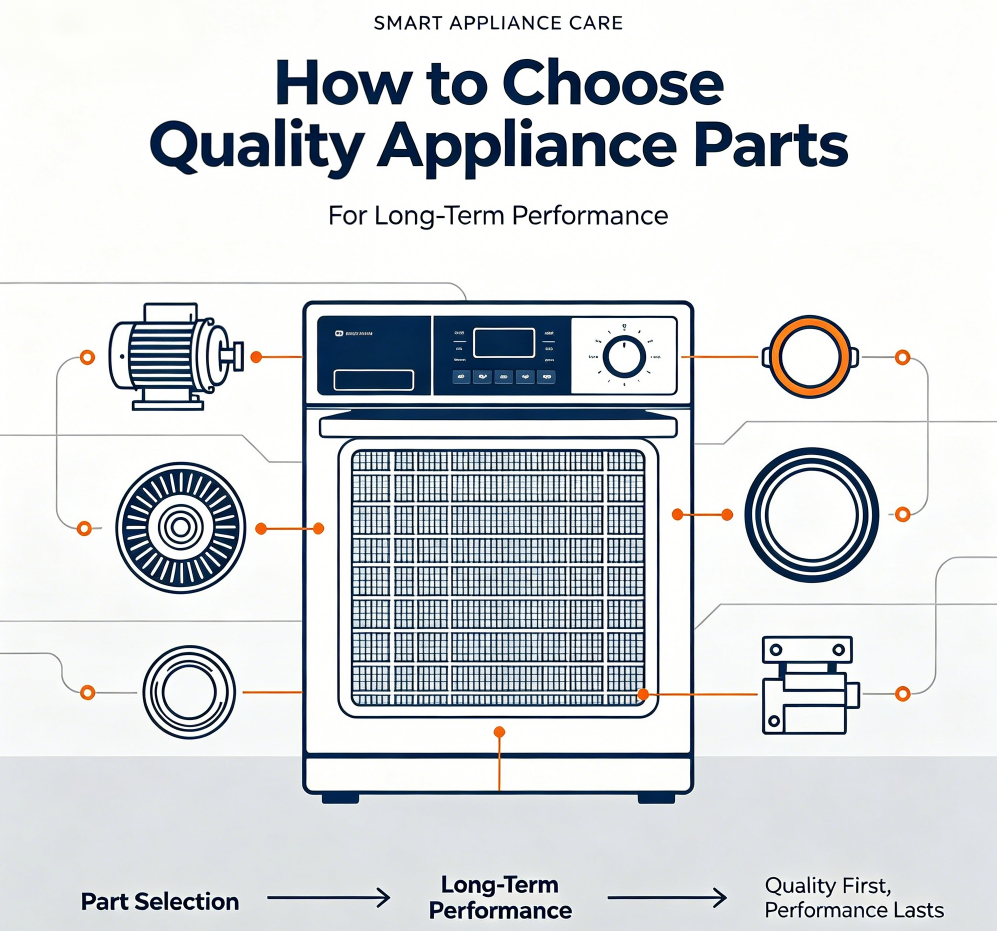
A Small Part Can Decide the Life of an Entire Appliance
People often judge an appliance by its appearance. A sleek refrigerator, a quiet washing machine, or a stylish air fryer leaves a good first impression. But once the product enters a customer's home, looks stop mattering.
What really determines whether that appliance still performs well five or eight years later? More often than not, it's the quality of the Home Appliance Parts inside.
I've visited factories where a single connector delayed production for days. I've also seen projects where changing to a slightly better engineering plastic reduced warranty claims far more than anyone expected. Those experiences make one thing clear: component quality isn't just an engineering issue—it's a business decision.
For manufacturers, purchasing managers, and product engineers, choosing the right Home Appliance Parts means balancing performance, cost, manufacturability, and long-term reliability. Cutting corners may lower the purchase price today, but it usually shows up later as service issues, product recalls, or damaged brand reputation.
This guide explains what really matters when evaluating appliance components, from materials and manufacturing processes to quality standards and supplier capability.
Table of Contents
· Why Component Quality Matters More Than You Think
· Understanding the Main Categories of Home Appliance Parts
· Material Selection: The Foundation of Reliable Performance
· Manufacturing Processes Behind High-Quality Components
· Quality Control That Goes Beyond Visual Inspection
· How to Evaluate a Home Appliance Parts Manufacturer
Why Component Quality Matters More Than You Think
A finished appliance is only as dependable as the components hidden inside it.
That sounds obvious. Yet purchasing decisions are still often driven by unit price instead of total lifecycle cost.
A plastic bracket that costs a few cents less may crack after years of repeated stress. A poorly plated metal terminal may develop corrosion in humid environments. A connector with inconsistent dimensional tolerance may fit perfectly during assembly but loosen after thousands of operating cycles.
Small defects rarely stay small.
According to UL Solutions, many electrical appliance failures originate from overheating, insulation degradation, poor electrical connections, or material aging rather than catastrophic design flaws. These issues often develop gradually over time, making component quality a critical factor in product safety and reliability.
For manufacturers, every component contributes to:
· Product durability
· Electrical safety
· Energy efficiency
· Manufacturing consistency
· Customer satisfaction
· Warranty cost
The cost of replacing a failed component in the field is almost always higher than selecting a better component during product development.
Understanding the Main Categories of Home Appliance Parts
Not every component works under the same conditions.
Some operate under continuous heat.
Others experience constant vibration.
Some must withstand chemicals, moisture, or repeated mechanical loading for years.
Understanding these operating environments is the first step toward selecting appropriate household appliance components.
Structural Components
These include:
· Mounting brackets
· Frames
· Support plates
· Reinforcement members
Although they often receive little attention, structural components determine mechanical stability throughout the appliance's service life.
Poor dimensional accuracy can create assembly problems long before the product reaches consumers.
Plastic Components
Many injection molded appliance parts serve both functional and cosmetic purposes.
Examples include:
· Control panels
· Handles
· Covers
· Knobs
· Fan housings
· Internal brackets
Plastic components must balance appearance with engineering performance.
Heat resistance, impact strength, dimensional stability, and flame-retardant properties often become equally important depending on the application.
Electrical Components
Electrical appliance spare parts include:
· Terminal blocks
· Connectors
· Switch housings
· Cable retainers
· Insulation supports
These parts must comply with strict safety requirements because electrical failures may directly affect user safety.
International standards such as IEC 60335 establish safety requirements for household electrical appliances, making component quality especially important.
Precision Mechanical Components
Moving assemblies require greater manufacturing precision.
Typical examples include:
· Shafts
· Gears
· Bearings
· Hinges
· Rotating supports
Even slight dimensional variation may increase vibration, noise, or premature wear during operation.
For this reason, precision appliance components usually require tighter manufacturing tolerances than appearance parts.
Material Selection: The Foundation of Reliable Performance
One question buyers ask almost immediately is:
"What material do you use?"
It's a reasonable question.
But experienced engineers usually ask something different:
"What operating environment was this material designed to survive?"
The answer tells you much more.
Engineering Plastics
Modern OEM home appliance parts rely heavily on engineering plastics because they combine lightweight construction with excellent mechanical properties.
The most common materials include:
Material | Typical Application | Key Advantages |
PP (Polypropylene) | Covers, storage bins | Lightweight, chemical resistant, cost-effective |
ABS | Control panels, exterior housings | Good surface finish and impact resistance |
PC (Polycarbonate) | Transparent covers | Excellent impact strength and heat resistance |
PA66 (Nylon) | Structural supports | High mechanical strength and wear resistance |
PBT | Electrical connectors | Excellent dimensional stability and electrical insulation |
Material selection should always match actual operating conditions.
For example, a dishwasher component exposed to elevated temperatures and moisture requires very different material properties than an air purifier housing operating at room temperature.
Metal Components
Metal parts remain essential in nearly every appliance category.
Depending on product requirements, manufacturers commonly use:
· Carbon steel
· Stainless steel
· Aluminum alloys
· Galvanized steel
· Zinc-coated steel
The choice depends on several engineering factors:
· Mechanical strength
· Corrosion resistance
· Weight
· Cost
· Manufacturing method
According to the World Steel Association, corrosion remains one of the primary factors affecting the service life of metal components operating in humid environments.
Surface treatment therefore becomes just as important as material selection.
Manufacturing Processes Behind High-Quality Components
The same material can produce very different results depending on how it's processed.
This is where experienced manufacturers distinguish themselves.
Injection Molding
For custom appliance parts, injection molding remains one of the most widely used production methods.
However, producing consistent parts requires tight control over several process variables:
· Melt temperature
· Mold temperature
· Injection pressure
· Cooling time
· Material moisture content
Even small deviations may result in:
· Warpage
· Sink marks
· Dimensional instability
· Internal stress
· Reduced impact strength
Many production problems actually begin long before final assembly.
Metal Stamping
Metal brackets and reinforcement parts often appear simple.
They're not.
High-quality stamping requires:
· Precision tooling
· Burr control
· Stable material thickness
· Consistent forming pressure
· Accurate hole positioning
If stamping tolerances drift outside specification, downstream assembly becomes much more difficult.
That's one reason experienced manufacturers continuously monitor tooling wear during production.
Surface Finishing
Surface finishing isn't only about appearance.
It directly influences durability.
Depending on application, manufacturers may apply:
· Powder coating
· Electroplating
· Anodizing
· Electrophoretic coating (E-coating)
· Galvanizing
A well-designed coating system improves corrosion resistance while maintaining dimensional consistency.
Quality Control That Goes Beyond Visual Inspection
Many suppliers proudly say:
"We inspect every batch."
That's encouraging.
But inspection means different things in different factories.
Professional home appliance parts manufacturers typically implement multiple inspection stages throughout production.
Incoming Material Inspection
Before production begins, raw materials should be verified for:
· Material certification
· Mechanical properties
· Chemical composition
· Moisture content (for engineering plastics)
Material consistency provides the foundation for stable production.
In-Process Inspection
During manufacturing, operators monitor:
· Critical dimensions
· Weight
· Surface quality
· Process parameters
· Functional characteristics
Detecting problems early prevents expensive rework later.
Final Product Verification
Before shipment, finished appliance replacement parts often undergo:
· Dimensional measurement
· Functional testing
· Appearance inspection
· Assembly verification
· Packaging inspection
Many international manufacturers also perform sampling according to internationally recognized quality standards such as ANSI/ASQ Z1.4.
Visual inspection alone is no longer sufficient for products expected to perform reliably over many years.
How to Evaluate a Home Appliance Parts Manufacturer
Choosing a supplier involves much more than comparing quotations.
A manufacturer capable of supporting long-term production should demonstrate strengths in several areas.
First, examine engineering capability.
Can the supplier assist with material recommendations?
Do they understand tolerance analysis?
Can they optimize component design for manufacturability?
Second, evaluate manufacturing consistency.
Ask about:
· Production capacity
· Process control
· Equipment maintenance
· Mold management
· Traceability systems
Third, review quality management.
Many reliable suppliers operate under ISO 9001 quality management systems, providing documented procedures for process control, corrective action, and continuous improvement.
Certification alone doesn't guarantee excellent products.
However, it demonstrates that quality management has been systematically implemented rather than handled informally.
Finally, don't overlook communication.
The best suppliers don't simply manufacture drawings.
They identify potential risks before production begins and work collaboratively to improve product performance.
That ability often creates more value than a slightly lower quotation.
Looking Beyond Price: What Experienced Buyers Really Evaluate
After the technical review comes another challenge—choosing the right supplier.
This is where many purchasing decisions become overly focused on unit price. It's understandable. Procurement teams work under cost targets, and every dollar matters. But for Home Appliance Parts, the purchase price is only one piece of the equation.
A supplier offering a component at 5% lower cost may introduce higher defect rates, unstable lead times, or inconsistent quality. Those hidden costs don't appear on the quotation sheet, but they certainly show up later in production schedules and warranty reports.
A more practical way to evaluate suppliers is to consider the total cost of ownership (TCO), including:
· Product quality consistency
· Manufacturing capability
· Engineering support
· Delivery reliability
· Response to quality issues
· Long-term production stability
For large-volume OEM projects, these factors usually outweigh a small difference in component price.
What Makes a Reliable Home Appliance Parts Manufacturer?
A supplier should be able to produce good parts repeatedly—not just one successful sample.
When auditing a home appliance parts manufacturer, experienced buyers often focus on several key areas.
Engineering Support
Can the engineering team understand your drawings?
Can they recommend better materials or manufacturing methods without increasing unnecessary costs?
Experienced manufacturers frequently identify potential problems before tooling begins, reducing expensive design revisions later.
Tooling Capability
For custom appliance parts, mold quality directly affects production consistency.
Questions worth asking include:
· Is tooling designed in-house or outsourced?
· How often is preventive maintenance performed?
· How is mold wear monitored?
· Can engineering changes be implemented efficiently?
A well-maintained mold often produces millions of consistent parts. A poorly maintained one gradually increases dimensional variation without anyone noticing immediately.
Production Automation
Automation doesn't automatically guarantee quality.
However, stable automated production generally reduces human variation.
Today's leading manufacturers increasingly use:
· Automated injection molding cells
· Robotic handling systems
· Vision inspection equipment
· Coordinate Measuring Machines (CMM)
· Statistical Process Control (SPC)
These technologies improve repeatability, particularly for precision appliance components produced in high volumes.
Why International Standards Matter
Quality claims should always be supported by recognized standards.
Several international standards are commonly referenced in the home appliance industry.
Standard | Purpose | Why It Matters |
ISO 9001 | Quality Management System | Ensures documented quality processes |
ISO 14001 | Environmental Management | Demonstrates sustainable manufacturing practices |
IEC 60335 | Household Appliance Safety | Covers electrical safety requirements |
UL Certification | Product Safety Testing | Widely recognized in North America |
RoHS Directive | Restriction of Hazardous Substances | Ensures environmental compliance for electronic products |
Meeting these standards doesn't automatically create better components.
What they do provide is a structured framework that reduces manufacturing risks and improves consistency.
Real Industry Case: Whirlpool's Focus on Component Quality
One example that illustrates the importance of component quality comes from Whirlpool Corporation, one of the world's largest home appliance manufacturers.
Over the past decade, Whirlpool has invested heavily in product reliability, manufacturing automation, and supplier quality management. According to the company's publicly available sustainability and annual reports, supplier audits, continuous quality improvement, and standardized manufacturing processes have become central parts of its global production strategy.
Rather than focusing only on finished products, Whirlpool evaluates suppliers based on:
· Manufacturing process capability
· Material compliance
· Product traceability
· Continuous improvement programs
· Sustainability performance
This approach reflects a broader trend across the appliance industry.
Large manufacturers increasingly recognize that improving OEM home appliance parts quality at the source is more cost-effective than resolving failures after products reach customers.
Source: Whirlpool Sustainability Report; Whirlpool Annual Report.
Common Mistakes Buyers Should Avoid
Over the years, a few sourcing mistakes appear again and again.
They're understandable—but they're also avoidable.
Choosing Materials Based Only on Cost
Engineering plastics may look identical on the surface.
Internally, however, different resin grades can vary significantly in:
· Heat resistance
· Mechanical strength
· UV stability
· Flame-retardant performance
· Long-term dimensional stability
Selecting a lower-grade material may reduce purchase cost while increasing failure risk.
Ignoring Manufacturing Capability
Two factories may quote exactly the same drawing.
One consistently delivers within tolerance.
The other struggles to maintain process stability.
The drawing hasn't changed.
The manufacturing capability has.
Focusing Only on Sample Approval
A perfect sample doesn't necessarily guarantee stable mass production.
Experienced buyers usually review:
· Process capability reports
· First Article Inspection (FAI)
· Process Flow Charts
· Control Plans
· Corrective Action procedures
Consistency matters much more than a single successful sample.
Underestimating Communication
Engineering projects rarely stay unchanged.
Design revisions happen.
Material substitutions become necessary.
Production schedules shift.
Suppliers that communicate quickly and transparently often prevent problems before they become expensive.
A Practical Supplier Evaluation Checklist
Before placing a large-volume order, consider asking these questions:
Evaluation Item | Key Question |
Engineering | Can they review drawings and recommend improvements? |
Materials | Are raw materials fully traceable? |
Manufacturing | Is key production equipment maintained regularly? |
Quality | Are inspection reports available for every batch? |
Capacity | Can production scale with future demand? |
Certifications | Do they maintain internationally recognized quality systems? |
Technical Support | Can engineers respond quickly during development? |
These questions often reveal far more than comparing quotations alone.
Frequently Asked Questions
How do I know whether a supplier's material claims are genuine?
Request material certificates from recognized suppliers, along with third-party testing reports when necessary.
For critical applications, independent laboratory verification can provide additional confidence.
Are OEM Home Appliance Parts always better than aftermarket parts?
Not necessarily.
OEM parts are manufactured according to the original product specifications, but many specialized component manufacturers also produce high-quality aftermarket parts that meet equivalent technical requirements.
The key is manufacturing capability and quality management—not simply the label.
Which manufacturing process offers the highest consistency?
There isn't a universal answer.
Injection molding, metal stamping, CNC machining, and die casting all deliver excellent consistency when supported by proper tooling, process control, and quality inspection.
Process management is usually more important than the process itself.
How often should suppliers be audited?
For strategic suppliers, many manufacturers conduct formal audits every one to three years, with ongoing performance monitoring based on quality, delivery, and responsiveness.
High-risk or newly qualified suppliers may require more frequent evaluations.
Final Thoughts
Selecting high-quality Home Appliance Parts isn't about finding the lowest quotation or the fastest delivery.
It's about building products that continue performing long after they leave the production line.
Reliable materials, capable engineering teams, stable manufacturing processes, and disciplined quality control all contribute to that goal.
As global competition becomes more intense, manufacturers are under growing pressure to improve reliability while controlling costs. The companies that succeed are often those that invest in better components early, rather than paying for failures later.
If you're sourcing household appliance components, developing custom appliance parts, or looking for a dependable home appliance parts manufacturer, start by evaluating technical capability—not just price. A thorough supplier assessment today can reduce production risks, improve product consistency, and strengthen customer confidence for years to come.
For projects with specific performance requirements, requesting detailed material specifications, quality documentation, and production capability information before mass production is a practical first step. It creates a clearer technical foundation for both buyer and supplier, helping ensure that every component contributes to the long-term performance of the finished appliance.